Wike’s FCT Machinery Deployed to Frustrate ADC’s National Convention
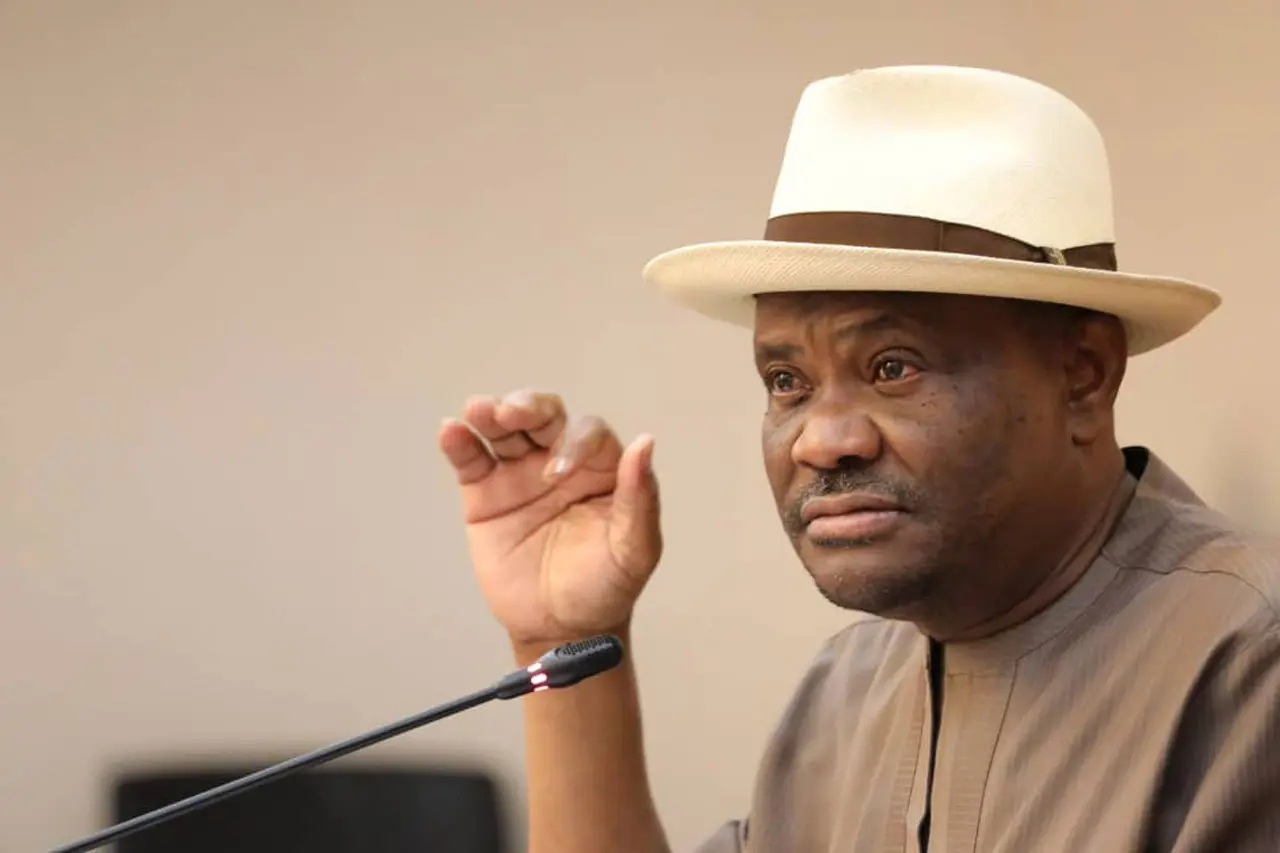
It began with an unanswered letter. It escalated into threats of licence revocation against a private businessman. And it ended with Nigeria’s most significant opposition gathering since the 2023 elections holding in defiance — at a venue that nearly pulled out at midnight. The battle over a convention hall for the African Democratic Congress on April 14, 2026 was not merely a logistical dispute. It was, opposition leaders say, a calculated exercise in democratic strangulation — and at the centre of the storm stood FCT Minister Nyesom Wike.
Barely 24 hours before its scheduled national convention, the ADC disclosed that it had yet to secure a venue in Abuja, raising fresh concerns over what the party described as attempts to frustrate its activities. Party chieftain Kola Ologbondiyan revealed that the ADC had made several attempts to secure venues in the Federal Capital Territory but was repeatedly turned down.
The party had formally approached the office of FCT Minister Nyesom Wike seeking approval to use Eagle Square, but received no response despite receiving an acknowledgment. “A letter was presented to the Office of the FCT Minister for a permit to use the Eagles Square. The letter was acknowledged but no response,” Ologbondiyan stated.
The party also explored using facilities at the Moshood Abiola National Stadium, including the Velodrome, but those efforts similarly came to nothing.
The ADC’s convention was no small affair. The non-elective convention was the first major assembly since a coalition of opposition politicians led by former Vice President Atiku Abubakar fused into the ADC in 2025. With about 3,000 delegates drawn from the 36 states and the FCT attending, the event was expected to affirm the David Mark-led National Working Committee, adopt the party’s amended constitution and manifesto, and consolidate opposition alliances ahead of the 2027 general election.
The venue troubles had actually begun before the Eagle Square saga. The Transcorp Hilton Hotel in Abuja cancelled the ADC’s booking for the national convention just days before the planned gathering, citing no public reason for the withdrawal. The cancellation followed a similar incident in 2025, when another Abuja hotel withdrew from hosting the unveiling of the ADC as an opposition platform, citing internal compliance issues.
The back-to-back cancellations by major Abuja hospitality venues raised immediate suspicions among opposition figures — but worse was still to come.
Rainbow Event Centre: The Midnight Threat
Having been refused Eagle Square and the National Stadium, and with Transcorp Hilton already out, the ADC settled on the Rainbow Event Centre in Garki, Abuja. Fees were paid, a contract was signed, and preparations — including decorations in party colours — were already underway at the venue. Then, hours before the convention was due to begin, the venue owner delivered a devastating message.
In a statement posted on X, ADC spokesperson Bolaji Abdullahi alleged that the management of Rainbow Event Centre had informed the party it had come under intense pressure from the Federal Capital Development Authority and FCT Minister Nyesom Wike, with threats that if the facility was used for the ADC gathering, the owner’s licence would be revoked. 
Abdullahi declared: “After paying all the fees required, setting up for our convention tomorrow, the owner of Rainbow Event Centre has just informed us that he has come under pressure from the FCDA and Minister of FCT, Nyesom Wike, that if he allows the ADC the use of his facilities, his licence will be revoked. But we have already signed the contract with him. We will hold our convention tomorrow as planned at the Rainbow Event Centre. We will not bow to this creeping tyranny. And definitely not to this petty tyrant.” 
The FCT Minister rejected the allegations with characteristic bluntness. Speaking to journalists during an inspection of ongoing projects in Abuja, Wike said no formal request had been submitted to his office or any relevant authority and insisted that Eagle Square remained open to all organisations that complied with established procedures. He described the allegations as unfounded and an attempt to court public sympathy. 
“We do not deny access; these events actually generate revenue for the government. Who denied them? I am not aware of any such development, and I don’t even know which party you are referring to. If it is the African Democratic Congress, such claims are their usual attempt to gain public sympathy,” Wike said. 
Wike also clarified that the Moshood Abiola National Stadium Velodrome — which had recently hosted a PDP convention backed by Wike himself — was under the control of the Federal Ministry of Sports and not the FCT Administration, distancing himself from responsibility for that venue as well. 
However, this explanation drew sharp scrutiny. The ADC produced what it claimed was a written request, and both sides dug in. The argument over who said what to whom was still ongoing the morning of the convention itself. 
Days later, after the convention had held, Wike went further. He denied ordering the revocation of the Rainbow Event Centre’s licence, announced that investigations had begun into the claims, and directed his Chief of Staff to identify any official who may have interfered.  In the same breath, he turned his fire on Atiku personally, saying the former Vice President should “wait until 2031” as there was “no space for him in 2027.”
The allegations unleashed a torrent of condemnation from opposition figures who described the events as a symptom of a government willing to undermine democracy to neutralise political rivals.
Former Vice President Atiku Abubakar alleged plans to prevent the ADC from holding its convention, describing the development as an abuse of public office. “The ADC has paid every fee. The ADC has signed every contract. The ADC has broken no law,” he declared. 
Atiku escalated his criticism further: “Coercing a private business owner to deny a lawfully registered opposition party the use of a venue is not governance. It is not politics. It is the naked conduct of a regime that has lost the argument, lost the people, and now reaches for the boot because it has nothing else left.” 
He warned that the alleged actions represented a broader pattern of democratic erosion: “This is how democracies are strangled — not in a single dramatic blow, but in a thousand petty, vindictive acts against opposition parties, against free assembly, and against the sacred right of citizens to choose their own leaders.” 
Former Anambra State Governor Peter Obi, speaking at the convention, said the country had been further divided by the current government and was now worse off than when President Bola Tinubu assumed power nearly three years ago. 
Despite the nocturnal drama, the ADC refused to blink. By late Monday night, the party confirmed Rainbow Events Centre as its venue. By Tuesday morning, delegates in colourful attire were streaming through security checkpoints, accreditation was underway, and the convention was alive. 
Over 3,000 delegates attended. Peter Obi was there. Atiku Abubakar was there. Rabiu Kwankwaso showed up. So did Rotimi Amaechi and Rauf Aregbesola — the man who now serves as the party’s National Secretary. Sitting at the head of it all was David Mark, former Senate President and ADC National Chairman, presiding over a convention his critics say he had no business running. 
Political analysts noted that repeated logistical and regulatory hurdles for opposition events — even if not proven as coordinated — can foster perceptions of an uneven playing field. The episode highlighted recurring questions about the operating environment for opposition parties in Nigeria, with overlapping legal disputes, venue challenges, and factional crises creating what some describe as “administrative friction” for parties attempting to consolidate ahead of major elections. 
The ADC convention drama is, in many ways, a microcosm of Nigeria’s deepening political polarisation as 2027 approaches. Whether the venue blockade was an orchestrated act of political suppression or a collision of bureaucratic dysfunction and poor planning by the ADC remains contested. What is not contested is the image it projected: of an opposition scrambling through the night for a room to meet in, while the machinery of the state — at least in perception — worked to deny them one.