Shot While Pleading: The Killing of Mene Ogidi and the Question Nigeria Cannot Escape
He was sitting on the ground, hands bound behind his back, begging for his life.
“I go tell you everything. Na my friend deceive me. E dey Sapele. I go carry you go the place,” the young man pleaded in Pidgin English, his voice audible in the now-viral video that has shaken Nigeria to its core. Seconds later, a gunshot rang out. Mene Ogidi, 28 years old, was dead.
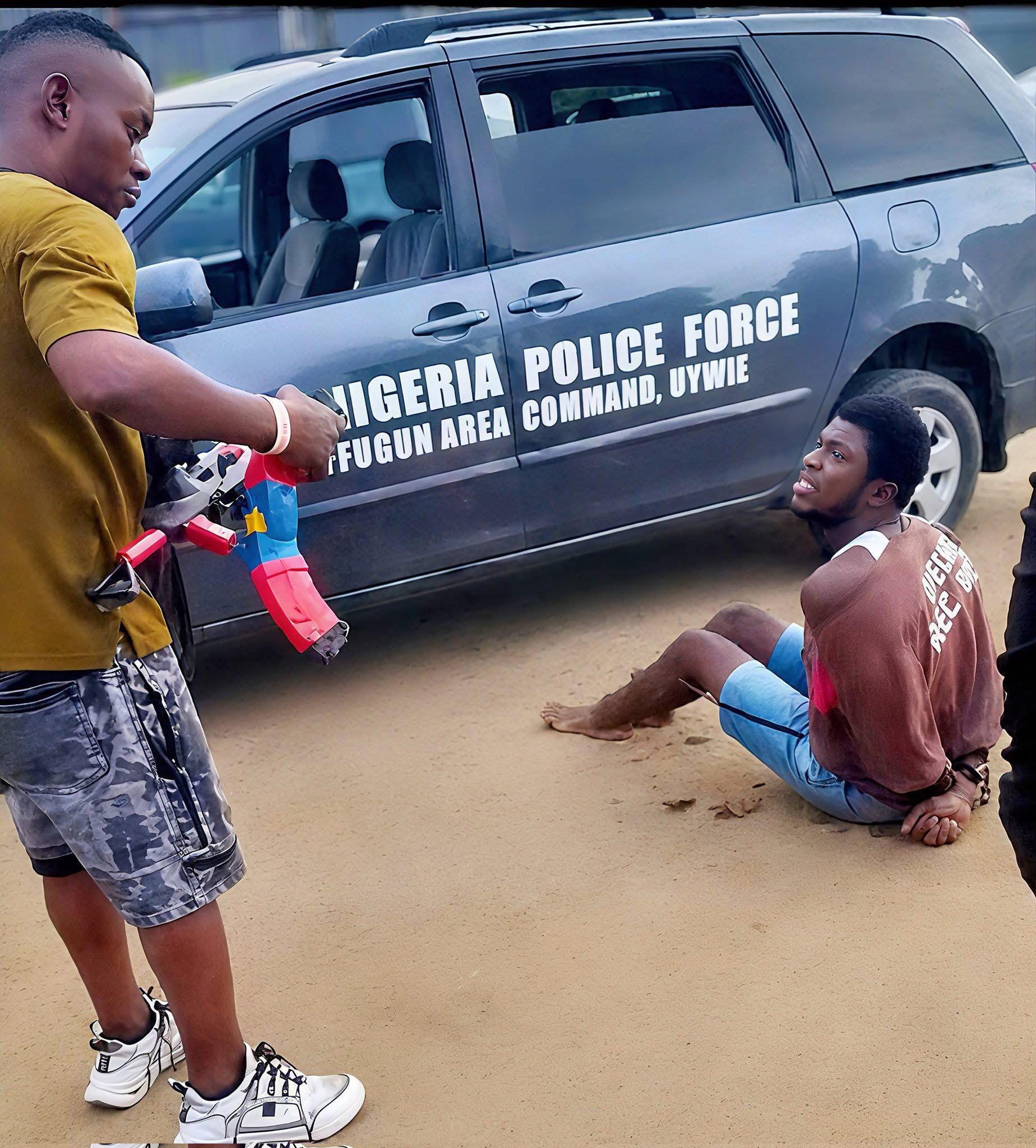
The killing occurred on April 26, 2026, in Effurun, Delta State, when operatives attached to the Effurun Area Command received intelligence about a suspect allegedly apprehended while attempting to waybill a parcel containing a Beretta pistol with four rounds of ammunition. Police operatives were deployed to take him into custody.  What happened next was not law enforcement — it was an execution.
The viral video shows Ogidi sitting on the ground with his hands tied behind his back, pleading with officers not to shoot him, promising to lead them to the person who gave him the weapon.  He was unarmed. He was restrained. He posed no threat.
Yet ASP Nuhu Usman, the team leader, discharged his firearm in clear violation of extant regulations, resulting in Ogidi’s death. 
Afterwards, the police officers carried the body into a Toyota Sienna vehicle bearing the inscription: “The Nigeria Police Force Effurun Area Command, Uvwie.”  There was no attempt to administer first aid. No ambulance was called. The scene was treated not as a crime, but as routine.
The “Spiritual Attack” Explanation
In the days that followed, the Delta State Police Command’s response added outrage to grief. In a televised interview, Delta State Police Public Relations Officer Bright Edafe described the killing as a “difficult moment” for the force — and attributed the officer’s actions to a “spiritual attack,” saying spirituality was the only explanation for what he did. 
The statement was met with immediate ridicule and fury across social media. Critics argued that in a country where police accountability remains alarmingly rare, deflecting a murder to the supernatural was not just absurd — it was dangerous. The explanation has since been widely condemned as emblematic of a force that protects its own at the expense of the citizenry.
Faced with overwhelming public pressure and a video that left no room for ambiguity, the Nigerian Police Force moved unusually fast. The Inspector-General of Police, Olatunji Disu, approved the dismissal and criminal prosecution of officers involved, following the conclusion of disciplinary proceedings. All officers connected to the incident were withdrawn from the Delta State Command and transferred to Force Headquarters in Abuja, where they underwent expedited disciplinary processes. 
The Force Disciplinary Committee found that ASP Usman acted in gross violation of Force Order 237 and other regulations governing the use of firearms, describing his actions as “unlawful, unprofessional, and a clear betrayal of the oath to protect life and uphold the law.” 
The statement from the Force added: “No uniform confers the right to take life outside the provisions of the law.”
Rights Groups Sound the Alarm
The killing has drawn condemnation from across the legal and human rights community.
Amnesty International described it as “horrifying that an unarmed young man who clearly posed no threat to anyone was gunned down at close range, in utter disdain for the right to life,” insisting such killings “cannot be justified under any circumstances whatsoever.”  The organisation warned that the incident signals what it called a “gradual return to the dark and horrible recent past of widespread police brutality.”
The Nigerian Bar Association, in a statement by its President, emphasised that the act violated the constitutional presumption of innocence and undermined public confidence in the police. “This incident represents an arbitrary and unacceptable use of power by a law enforcement agent,” the statement read, warning that if unchecked, such actions could erode fundamental rights and foster a culture of impunity. 
Avocats Sans Frontières France (Lawyers Without Borders) also weighed in, calling the murder a “total collapse of due process” and a flagrant violation of the fundamental right to life protected by Section 33 of the 1999 Constitution. 
The Police Service Commission condemned the act as a violation of Nigerian laws and international humanitarian standards, including the International Humanitarian Law, the Constitution of the Federal Republic of Nigeria, the Anti-Torture Act 2017, and the Administration of Criminal Justice Act 2015. 
For many Nigerians, the Ogidi case is not an isolated incident — it is a familiar story in a different city. The #EndSARS protests of 2020 were sparked by years of identical abuses. Promises of reform followed. Police units were dissolved and reconstituted. Yet here, in 2026, a handcuffed man was shot dead on a roadside in Delta State while the camera rolled.
Actor Stanley Ontop captured the public mood when he wrote: “Delta State Command has turned into a police abattoir. The extrajudicial killings happening in Delta State now are becoming too worrisome and have to stop.” 
The dismissal of ASP Usman and his associates is, at minimum, a beginning. But justice for Mene Ogidi — and for the countless others whose deaths were never caught on video — demands more than a dismissal. It demands a reckoning with a culture of impunity that has long been allowed to fester within Nigeria’s law enforcement institutions.
A 28-year-old man is dead. He was not convicted. He was not tried. He was not given the chance to lead officers to the person who deceived him, as he begged to do in his final moments.
He was shot. And for years, that would have been the end of the story.
This time, Nigeria is watching.