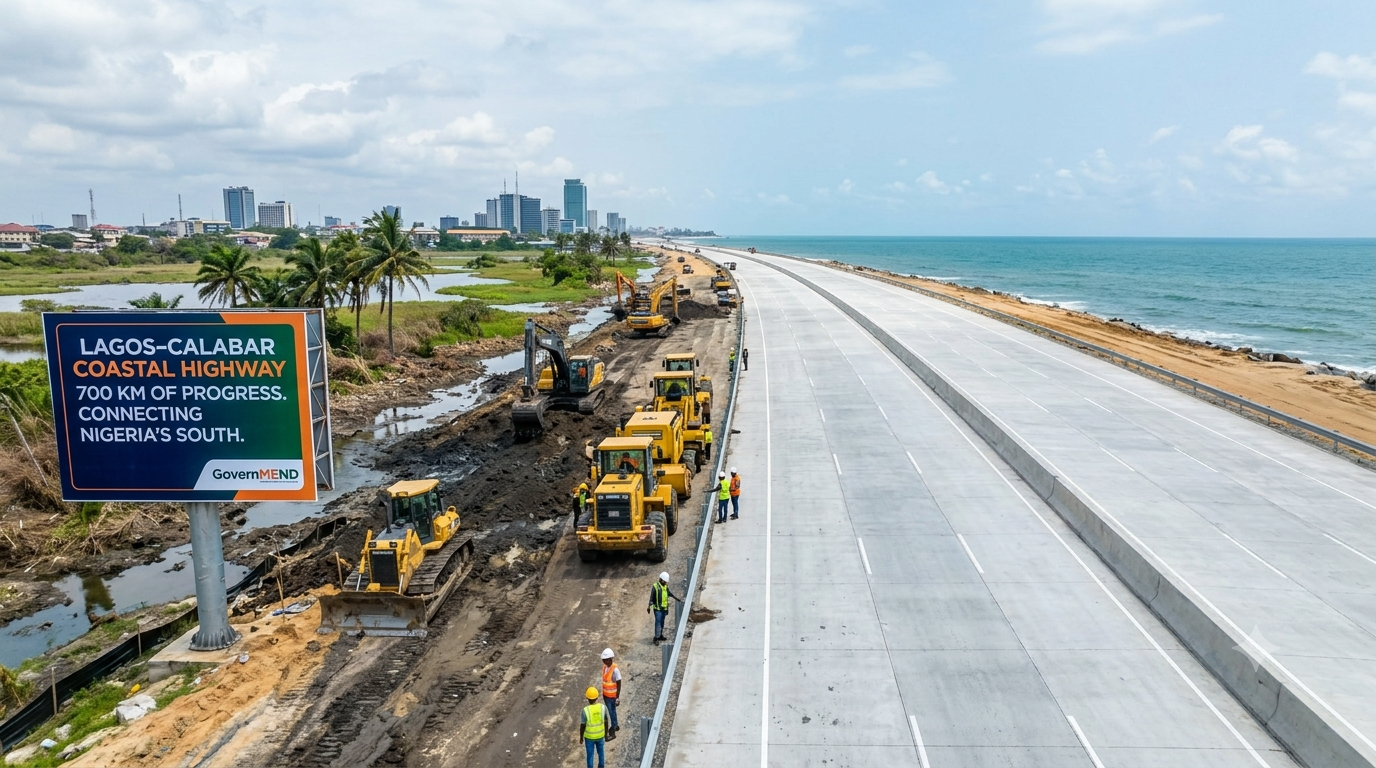
The Road Every Nigerian President Promised. So Why Is This One Different? The Lagos-Calabar Coastal Highway
There’s a particular kind of Nigerian scepticism reserved for big infrastructure announcements. We’ve heard “this will be completed in three years” too many times — about Ajaokuta Steel, about the Second Niger Bridge, about the Abuja–Kaduna rail line that took a decade. Is the Lagos–Calabar Coastal Highway actually different, or is it just the latest chapter in a very old Nigerian story?
The honest answer, once you dig past the press briefings, it’s: a bit of both.
A 50-Year-Old Promise
The idea of a road linking Lagos to Calabar along Nigeria’s southern coastline isn’t new. It first surfaced in the late 1970s as part of a broader vision to open up the country’s coastal states, and it stalled for decades afterward, undone by funding gaps and changes in government, according to an adviser to the current works minister who spoke to Mongabay.
The project actually got dressed up in different clothes more than once. Under President Goodluck Jonathan, it was conceived as a railway and handed to the China Civil Engineering Construction Corporation in a $12 billion deal that collapsed when Jonathan left office in 2015. President Muhammadu Buhari’s administration revived it in 2016 as an $11 billion project with a three-year deadline that came and went without much to show for it, per reporting by Swiss news outlet SWI.
President Bola Tinubu’s own connection to the project goes back even further: as governor of Lagos State roughly 27 years ago, he first floated the idea of a coastal road linking Lekki to the rest of the south, according to Works Minister David Umahi. That personal history is part of why the government recently renamed the project the “President Bola Ahmed Tinubu Coastal Highway”, a move that has itself drawn some eyebrows.
What’s Actually Being Built
Strip away the politics and the numbers alone are staggering. The highway is designed to run roughly 700–750 kilometres from Victoria Island in Lagos to Calabar in Cross River State, cutting through Ogun, Ondo, Edo, Delta, Bayelsa, Rivers, and Akwa Ibom along the way. In its busiest stretches, it’s planned as a 10-lane dual carriageway with a standard-gauge rail corridor running down the median. A multi-modal design without real precedent in West Africa, according to a Guardian Nigeria op-ed comparing it to America’s mid-century interstate system.
The government’s total cost estimate has moved around depending on who’s talking and when figures ranging from roughly N15.6 trillion to a widely cited $13 billion have circulated in the press. Minister Umahi has pushed back on some of the higher per-kilometre figures floated by critics, insisting construction is proceeding at about N4 billion per kilometre rather than the N8 billion figure former Vice President Atiku Abubakar cited.
The Progress: More Than a Photo Op
To the government’s credit, this is one of the few “legacy” road projects under the current administration that isn’t simply a rehabilitation of something abandoned by a previous government. Umahi has pointed out that the coastal highway and the Sokoto–Badagry Superhighway are the only entirely new federal roads Nigeria has built in this cycle, with virtually everything else on the ministry’s list being inherited, abandoned work.
Since President Tinubu flagged off the project in May 2024, the first 47.47-kilometre stretch from Ahmadu Bello Way in Victoria Island toward Eleko in Ibeju-Lekki has moved from drawing board to daily use. The Federal Ministry of Works opened a section to the public in December 2025, and by early 2026 residents of Ajah, Ogombo and Sangotedo communities were reportedly telling reporters their commute had shrunk by up to an hour. The contractor, Hitech Construction Company, has committed to finishing the full 106-kilometre Sections One and Two by December 2026. That’s a genuinely unusual pace by Nigerian standards.
The Cracks Beneath the Concrete
But the closer you look, the messier it gets and this is where the “until now” framing starts to feel premature.
The most persistent controversy is how the contract was awarded. Rather than going through open competitive bidding, the project was handed to Hitech Construction Company Limited, owned by brothers Gilbert and Ronald Chagoury, with Gilbert Chagoury widely reported as an ally of President Tinubu through what the government calls “restrictive procurement,” citing the firm’s specialised equipment and prior coastal reclamation work in Lagos. Critics, including Atiku Abubakar and the pan-Yoruba group Afenifere, argue this bypassed the Public Procurement Act’s competitive-bidding requirements. A Guardian Nigeria analysis goes further, calling Umahi’s legal justification “fundamentally flawed” and a policy analysis from the Athena Centre for Policy and Leadership notes the initial award came without Federal Executive Council approval or a public tender.
The funding story has also shifted more than once. Umahi initially described the deal as a fully contractor-financed arrangement; the government has since disclosed allocating $3.6 billion in public funds toward construction, and separate reporting has referenced a roughly $747 million loan facility tied to the project. For a country with rising public debt, “who’s actually paying for this” isn’t a small question and independent legal analysts have called for the government to publish the full bill of quantities, loan term sheets, and environmental compliance documents to settle it.
The Human and Environmental Toll
Then there’s the cost that doesn’t show up in a per-kilometre figure. The highway’s route cuts directly through densely populated, commercially valuable coastline including parts of Lagos’s Landmark Beach, where a reported $200 million leisure complex faced demolition. Business owners and residents have said bulldozers arrived with little warning or consultation, and while the government has disbursed more than N15 billion in compensation to affected property owners, several displaced residents say it doesn’t come close to covering what they’ve lost.
An investigation by Mongabay also flagged the highway’s path through ecologically sensitive mangrove and wetland areas along the coast the kind of biodiversity hotspots that, once paved over, don’t come back. A recent academic paper describes the project as something that cannot be reduced to its economic or logistical dimensions alone, calling it as much a political and environmental flashpoint as an infrastructure win.
So, Is This Time Actually Different?
Here’s where a fair reading has to hold two things at once.
On one hand: this is the furthest the Lagos–Calabar dream has ever gotten. Concrete is down. People are driving on it. Jobs are being created, estimates put direct construction employment near 10,000, alongside the promised long-term boost to trade, tourism and the “blue economy” along Nigeria’s southern coast. Lagos State governor Babajide Sanwo-Olu said in January 2026 that the project was already yielding economic dividends for the state.
On the other hand: procurement irregularities, shifting funding claims, unresolved compensation disputes, and unaddressed environmental concerns are exactly the kind of unfinished business that has derailed Nigerian megaprojects before, just usually further down the road, once the cameras move on. A recent Businessday analysis drew a pointed comparison to Nigeria LNG, a project that also took nearly 50 years from concept to reality, and asked whether the coastal highway can escape the “Nigerian factor” that has swallowed so many similar ambitions.
The honest conclusion isn’t “this time is different” or “this is another Ajaokuta.” It’s that Nigeria has, for once, built something instead of only promising it and whether that becomes a genuine turning point depends on whether the government now submits to the scrutiny it avoided at the contract’s starting line. A road that finally gets built badly, or unaccountably, is still a road that got built badly.
For a country whose infrastructure history is littered with abandoned steel plants and half-finished bridges, that’s progress worth acknowledging carefully, and with the receipts still open for inspection.
References
- Mongabay — Nigeria’s new coastal highway runs over communities & biodiversity hotspots
- SWI swissinfo.ch — Nigeria Taps Tinubu’s Ally to Build a $13 Billion Highway
- Nigeria Housing Market — Umahi Announces Renaming of Lagos-Calabar Coastal Highway in Honour of Tinubu
- The Guardian Nigeria — Lagos–Calabar Coastal Road project: Embracing global best practices
- Punch — Lagos-Calabar coastal highway costs N4bn per kilometre – Umahi
- The Nation — Critics of Lagos-Calabar Coastal Highway are envious of Tinubu’s unprecedented achievements – Umahi
- Blueprint Newspapers — Lagos-Calabar coastal highway of hope, progress
- The Guardian Nigeria — That controversial Lagos-Calabar coastal highway project
- Vanguard — Afenifere: N15.6 trillion Coastal Highway contract is ill-advised
- Athena Centre for Policy and Leadership — Advancing Accountability and Sustainability: Understanding the Procurement Conundrum of the Lagos-Calabar Coastal Highway Project
- 1st Attorneys — Highway or Highway Robbery? A Deep Dive into the Cost, Contracts, and Controversies of the Lagos–Calabar Coastal Project
- The Journal Nigeria — The Lagos-Calabar Coastal Highway Conundrum: Balancing Development and Concerns
- Federal Ministry of Information and National Orientation — Lagos-Calabar Coastal Highway: An Update on Construction Progress
- LASU Postgraduate School Journal (ResearchGate) — Mapping the Coastline: Assessing the Cost, Politics and Promise of the Lagos-Calabar Coastal Highway
- Leadership — Beyond The Road: Potential Ripple Effects Of Lagos-Calabar Coastal Highway
- AllAfrica — Nigeria: Coastal Highway Project Already Yielding Economic Dividends in Lagos – Sanwo-Olu
- Businessday NG — First look at the Lagos coastal road opportunities and challenges