At UN, Mahama warns against new scramble for Africa’s resources
Ghanaian President John Dramani Mahama has warned that Africa will not allow the growing global demand for its critical minerals to lead to a repeat of the resource exploitation associated with the colonial era.
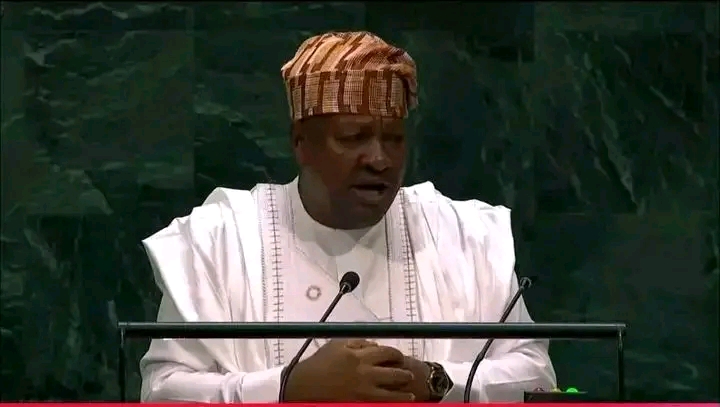
Mahama gave the warning on Thursday while addressing world leaders at the 81st session of the United Nations General Assembly in New York, where he called for greater African control over the continent’s natural resources.
The Ghanaian leader said Africa must move away from the long-standing practice of exporting raw materials while other countries carry out the processing and benefit from much of the value created.
“Let me warn: Africa will not remain a passive arena for a new scramble for resources. Critical mineral extraction must not replicate colonial-era exploitation,” Mahama said.
He added, “We will process our minerals at home, build local industries, create dignified jobs for our youth, and retain the value of our natural resources.”
Mahama’s remarks came amid growing global demand for critical minerals used in renewable energy, electric vehicles, batteries and other technologies.
He said Africa possesses many of the resources needed for the global transition to green energy, as well as a large and youthful population that could benefit from the industrial opportunities created by the sector.
According to the President, African countries should use their mineral wealth to drive industrialisation, create jobs and strengthen their economies instead of remaining suppliers of raw materials to industries outside the continent.
He also called for stronger economic cooperation among African countries, pointing to the African Continental Free Trade Area as an important platform for expanding trade, supporting local industries and promoting economic transformation.
“The African Continental Free Trade Area, whose Secretariat Ghana is proud to host in Accra, is our engine for intra-African trade, structural transformation and industrial growth,” he said.
Mahama stressed that Africa was not asking for charity from the rest of the world but for an economic relationship based on mutual respect and equal partnership.
“Africa does not seek charity. Africa seeks equal partnership anchored in mutual respect,” he said.
The Ghanaian President also linked Africa’s demand for greater control over its resources to wider concerns about the international economic system. He called for reforms to global trade and financial structures, arguing that developing countries face high borrowing costs and debt pressures that limit their ability to invest in infrastructure, human capital, industrialisation and climate adaptation.
He also criticised what he described as the continued export of African raw materials while much of the value addition and job creation takes place outside the continent.
Beyond economic issues, Mahama used his UN address to renew Africa’s call for permanent representation on the United Nations Security Council. He argued that Africa’s absence from the permanent membership of the Council was no longer acceptable and called for the continent to have permanent representation with the rights and responsibilities attached to such membership.
The President further addressed issues surrounding historical injustice, including the transatlantic slave trade, and called for reforms that would address what he described as continuing inequalities in global political and economic structures.
The 81st UN General Assembly is taking place in New York from September 22 to 28, with world leaders using the high-level debate to address issues ranging from global security and economic inequality to climate change and international cooperation.
Mahama’s call for local processing of Africa’s critical minerals reflects a wider debate over how the continent can capture more economic value from its natural resources as demand for minerals linked to the global energy transition continues to grow. The UN’s Office of the Special Adviser on Africa has also warned that the current mineral boom could repeat the old pattern of Africa exporting raw materials while much of the wealth is created elsewhere.